

February 11
We rise well before dawn to get to the airport for our early flight to Lima. A
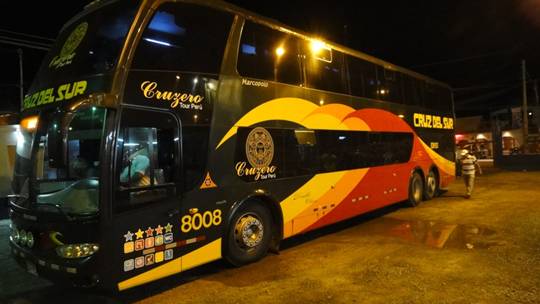
taxi takes us from Lima airport, across the city to the Cruz Del Sur bus
terminal. It is my first experience with the luxurious long-distance buses of
South America and I am enormously impressed. Greyhound could learn a few things
from these companies. The buses are huge, very smooth and comfortable. We opt
to pay an extra $8.00 for first class. This allows us to ride on the lower
level, while the second-class passengers ride upstairs. The first class
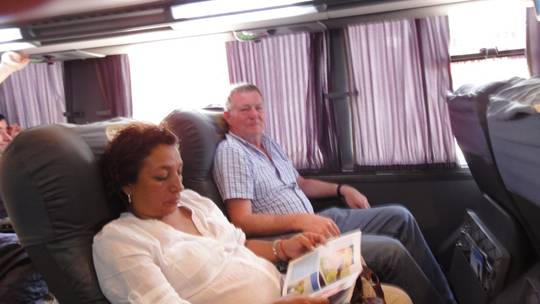
compartment has only twelve seats, set three-across, so they are wider than normal,
like the first class seats on an airplane. They recline nearly flat for
sleeping, with lots of legroom to stretch out. A steward serves a hot meal and
offers soft drinks and snacks. First class has its own toilet (only 'number
one' is permitted -- we aren’t sure how they monitor that).
|
|
|
|
Cruz Del Sur Cruzero service |
First class comfort |
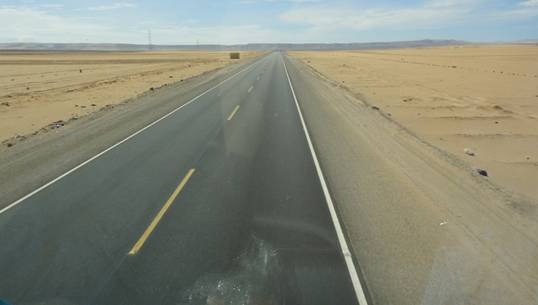
This part of Peru must be the driest, dustiest place I have ever seen! An enormous desert stretches from the border with Ecuador all the way down into Chile. This is a desert that makes Arizona look green and lush. For miles and miles there is nothing but sand – not a bush or a cactus or any green living thing!
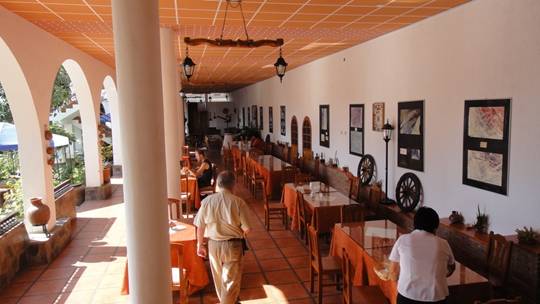
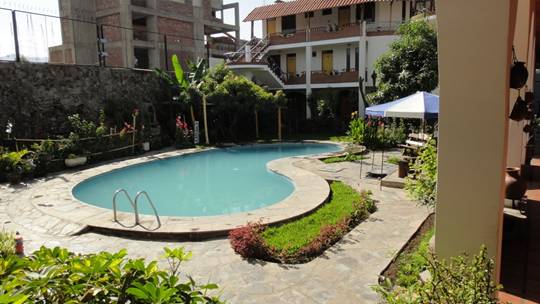
Around 9:30 pm, the bus pulls into Nazca. We walk across the street to the Hotel Alegria and check in. The hotel is a delight! It looks quite plain from the street, but inside is a lovely central courtyard with a pool. The restaurant on the ground floor and the rooms above open out onto shady arched arcades. Our room is plain, but comfortable and we get a good night’s sleep.
|
|
|
|
Hotel Alegria in Nazca |
|
February 12
Nazca is the site of the famous Nazca Lines. Early inhabitants scraped the
overlying red stones away to expose white sand underneath, making designs that
can really only be appreciated from the air. There are many figures of
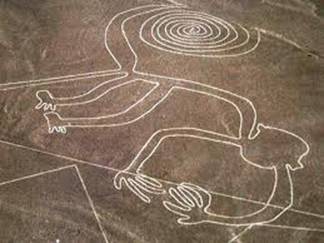
animals: monkey, spider, condor, whale, and many other geometrical shapes. Of
course, everyone wonders how this primitive society could create such things
when they themselves were unable to see them from the air; of course, one also
wonders why they bothered. Eric von Daniken, in his book, Chariot of the Gods,
proposed that they were navigational markers for extra-terrestrial visitors, but
that theory has been pretty much abandoned. There is, however, one figure
called The Astronaut and it looks exactly like a man in a spacesuit! Of
course, we can’t come to Peru and not see the Nazca lines, so we take the obligatory
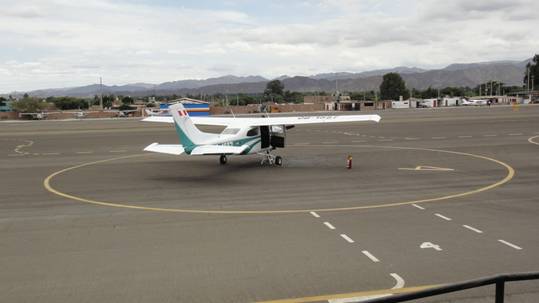
sight-seeing flight. Half an hour in a Cessna 206, doing tight turns at low
altitude in bumpy air is exciting in itself. The lines and figures are pretty
cool too; definitely worth seeing. I take about fifty pictures of the lines and
figures, but my little digital camera doesn’t do them justice. Usually the
plane bounces just as I press the button and I take a picture of empty desert
instead of a figure. If you would really like to see them, go to
http://en.wikipedia.org/wiki/Nazca_lines
|
|
|
|
Our sight-seeing flight |
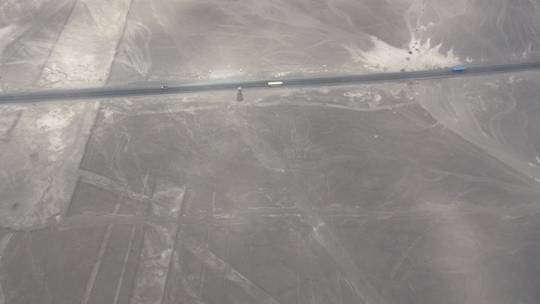
There is a figure in there somewhere – honest! It is just below and to the right of the bus |
|
|
|
|
The monkey |
The astronaut |
After the flight, we have to wait around until our next bus at 10:30 pm. Nazca is a dusty little desert town, without a whole lot of interest, but we walk around, find the parque central and do some people watching. We try to find a park bench that is actually in the shade, but we quickly realize that you can easily tell which benches are in the shade, because they are the ones that already have people sitting on them. Then we notice a fancy hotel that looks like it might have a cool and comfortable bar. Disguised as wealthy gringos, we saunter in and make a single beer last for nearly two hours.
In the fullness of time, our bus is ready to leave. Once again we splurge for first class seats – an excellent investment for an overnight journey. There are convenient footrests, the seats recline almost flat and are wide enough to be really comfortable. We sleep like babies until the bus pulls into Arequipa at 7:30 in the morning.
February 13
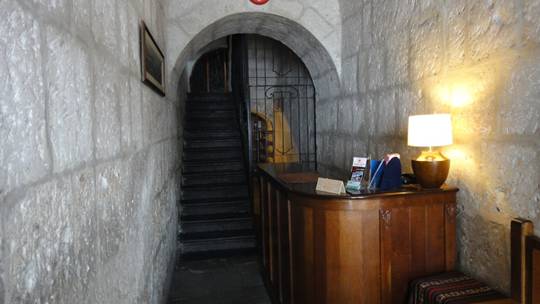
A taxi takes us to the Hostal Casablanca, only a few meters from the central
square. It is a lovely old building, built out of the soft white volcanic
stone, called sillar. Most of the older buildings are built of this
material, which is why Arequipa is called The White City.
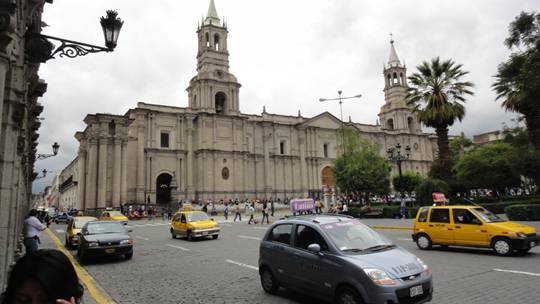
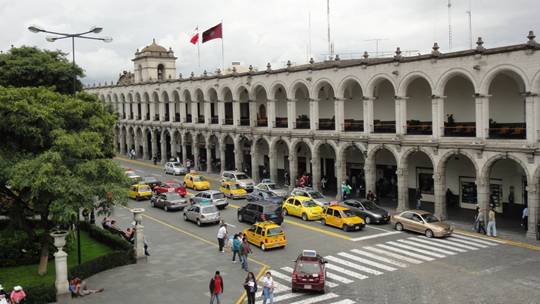
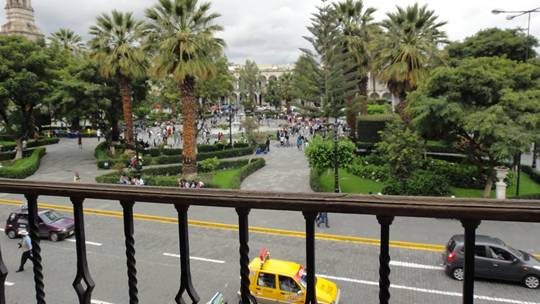
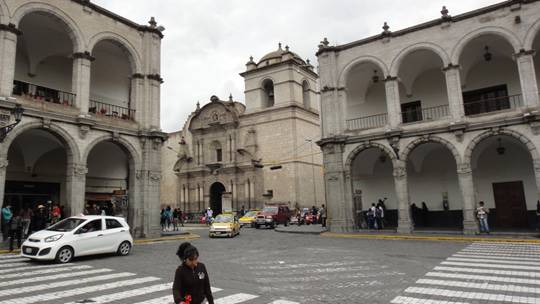
We spend a few hours organizing the next phase of our journey and just walking around the lovely Plaza de Armas. I think these central squares are the feature I like most about colonial cities. They are the focal point of the community and are always bustling with people. There is a vibrant, busy atmosphere that is very appealing. We also tour the magnificent cathedral that dominates one whole side of the square. The other three sides are lined with classical buildings of white sillar stone. The façades consist of arched arcades so you can walk all the way around the square, while staying in the shade. There are arcades on the second floor, too and we soon discover that they contain numerous restaurants. We have a lovely lunch, looking out through the arches and watching the activity in the square below. One of the dishes on the menu catches our eyes and we can’t resist trying it: alpaca stir fry. It is delicious!
|
|
|
|
Entrance to Hotel Casablanca |
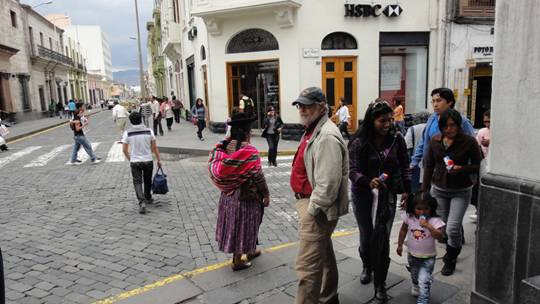
Gringo tourist in Arequipa |
|
|
|
|
Arequipa cathedral |
Arcades all around the square |
|
|
|
|
View of the busy square from a second floor restaurant |
Older Jesuit church |
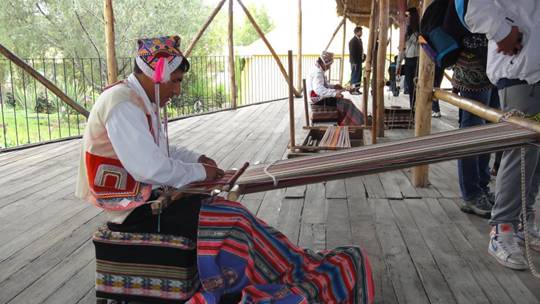
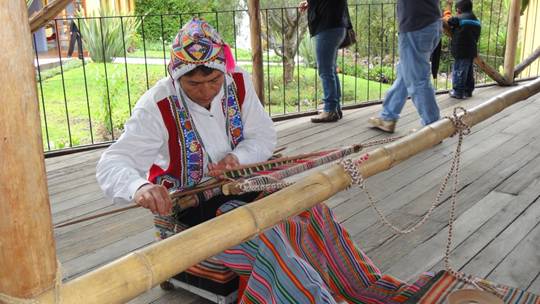
In the afternoon, we take a double-decker bus tour of the city. The bus stops at a llama and alpaca interpretive centre. Mike says: “What do you think they will do if they find out we ate one for lunch?” It is actually very interesting. We are introduced to llamas, alpacas, vicuñas and guanacos. The alpacas seem to bear us no grudge! Indigenous people, in colourful, traditional dress, demonstrate weaving and spinning, the way it has been done for centuries. We are encouraged to fondle gorgeous fabrics woven from the various wools. Vicuña wool is the softest (and most expensive) fiber in the world.
|
|
|
|
Weavers, in their traditional dress, demonstrating their craft |
|
The centre of Arequipa is very attractive, but outside of that, we don’t think it has much appeal. Peru is, for the most part, a very poor country and large areas of the city are desperate slums. It is quite possible that there are some very pleasant areas, but we didn’t see them.
February 15
We get an early morning bus for the five-hour ride to Tacna. This is a day-time
ride so we buy second-class tickets and ride upstairs with the common people.
We manage to get the two front seats, giving us a panoramic view of the
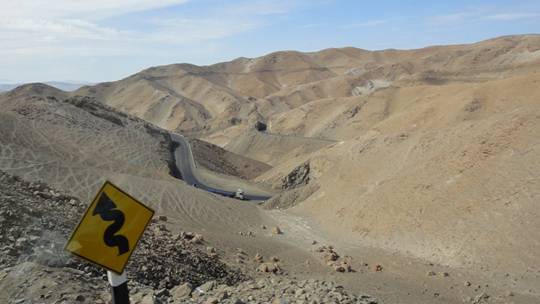
countryside. The countryside is more miles and miles … and miles and miles
... of
absolutely barren desert. Neither of us can believe that a desert can be this
dry or this huge. Periodically, the terrain is interrupted by a massive valley,
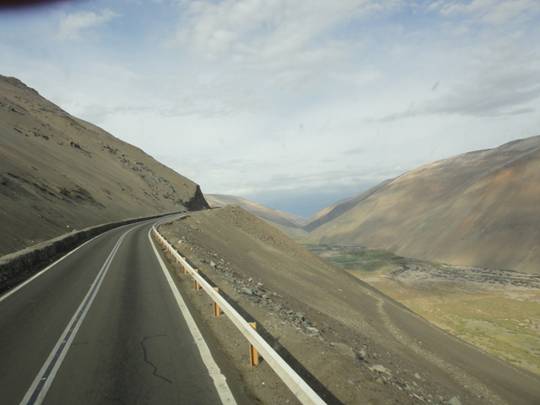
which we have to cross. The bus suddenly begins a descent down switchback roads
until it comes to the valley floor. One of these valleys is easily 3000 feet
deep; a sign at the top says: Downhill Grade For 20 Km. In these valleys, there is usually enough water to
support some plant life; even a small river
providing water for irrigation. These places are lush and green and grow many
crops: fertile fields of alfalfa, grazed by fat cattle, as well as
vegetables, fruit trees and even vineyards. Then the bus climbs back up out of
the valley onto the desert again.
|
|
|
|
Highway winds in and out of deep valleys… |
…then it goes arrow-straight across endless desert |
|
|
|
|
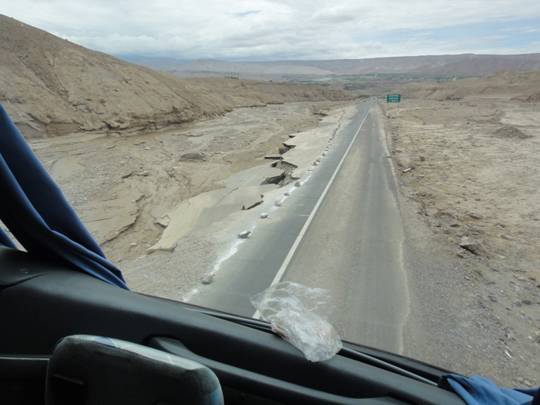
This year's unusually heavy rainfall takes its toll on the roads |
Road climbs out of huge valley |
The bus deposits us in the Peruvian border town of Tacna. We walk out of the terminal and find a collectivo (private taxi that gathers up passengers until it is full), which takes us the 40 Km, through the border to Arica, Chile. The collectivo is a good deal as the driver hurries us through the many customs and immigration counters on both sides of the border. This is one time when we didn’t book a hotel in advance and it turns out to be a bit of a struggle to find one. Arica is a resort town and it is summer. Also, we are just a few days from Carneval. We ask a taxi driver to recommend a hotel and he takes us to several, with no success. Each one either has no rooms or else they don’t have a room with two beds, “...solo un matrimonio”. Certainly, Mike and I are getting along just fine on this trip but we definitely prefer separate beds. We end up at the very nice Hotel Savona. They also do not have una habitacion con dos camas, but they DO have two single rooms available. We make an executive decision and soon we are settled in.
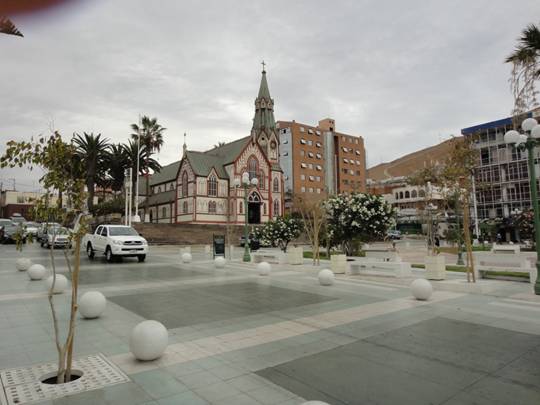
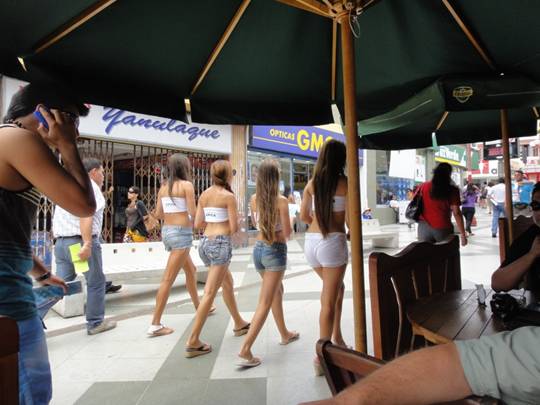
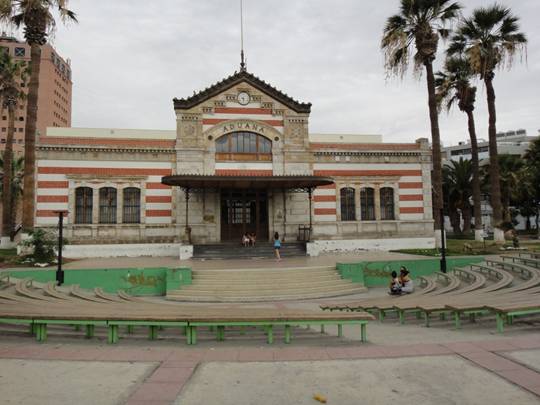
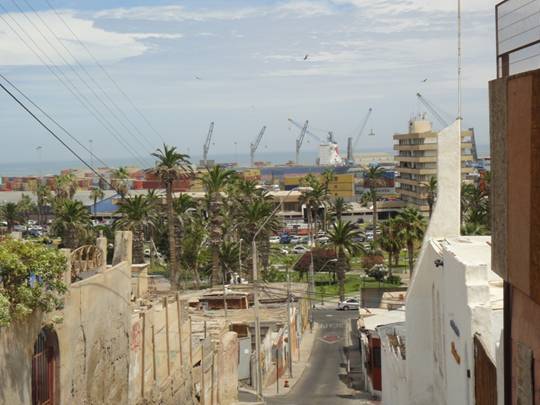
Arica has a parque central complete with cathedral, but it is virtually empty apart from a contingent of skateboarders. Just a block away, though, is a lovely pedestrian mall with shops, restaurants, cafes and bars – and a thousand or so local inhabitants, strolling up and down, sitting in the cafes and generally creating an appealing, vibrant atmosphere. We walk up and down, have a beer (or two) in the cafes and watch the people. There are one or two pretty girls in Chile! The cathedral is unique. It is constructed of wrought-iron and was designed and pre-fabricated by Gustave Eiffel in France, then shipped to Arica and erected in the central square.
|
|
|
|
Central square and wrought-iron cathedral in Arica, Chile |
Pedestrian mall |
|
|
|
|
Classic old building near the port |
Busy port of Arica |
February 16
Alas, the Hotel Savona has no room for us for tonight. We settle for a
“boutique hotel”, called Hotel Beltrain. “Boutique hotel” seems to mean that
the room has fancy bathroom fixtures and charges twice as much. It
doesn’t seem to mean that the room is any bigger, that it has air conditioning
or that the beds are any better. Nevertheless, we do have a place to stay and
that is a good thing!