

February 17
Another comfortable bus ride to Iquique, Chile; yet more vast expanses of
desiccated desert and more stunning descents into bottomless valleys. Here and
there, we see the deserted remains of nineteenth century nitrate mines.
Northern Chile contains the world’s largest deposits of sodium nitrate, or
saltpeter. During the eighteenth and nineteenth centuries sodium nitrate had
enormous strategic importance because it is the key component in gunpowder. All
those cannons on all those sailing ships and forts used gunpowder. Unfortunately for the
Chilean nitrate industry, the wily Germans invented a process for making cordite
or smokeless powder that doesn’t require saltpeter. We pass a totally deserted
ghost town called Humboldt, which stands essentially unchanged from the day the
mines shut down and everybody left.
|
|
|
|
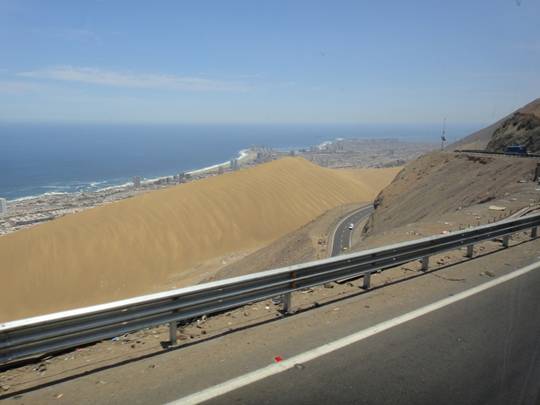
Between the city of Iquique and the cliffs, lies the biggest single sand dune in the world |
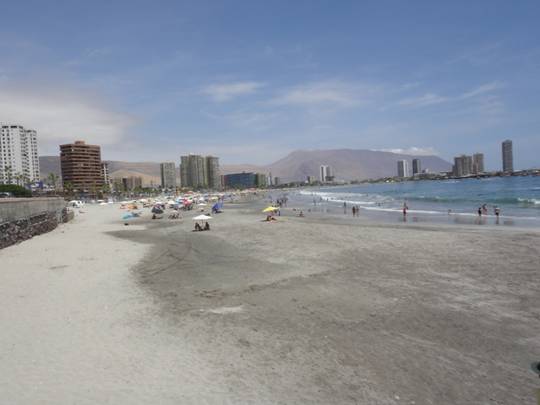
Popular beaches right in the city |
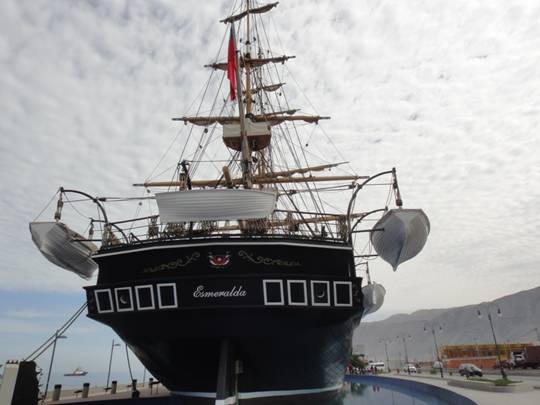
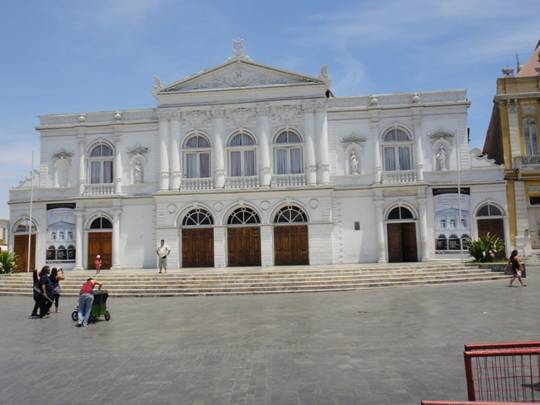
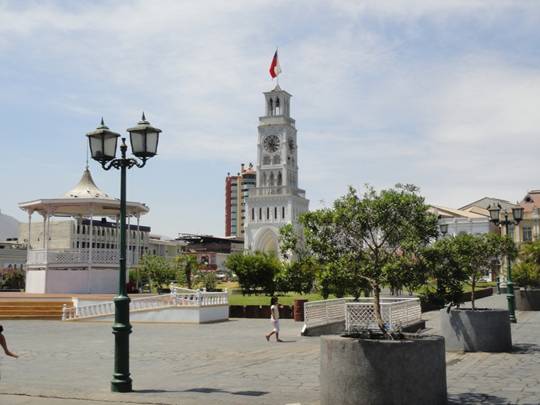
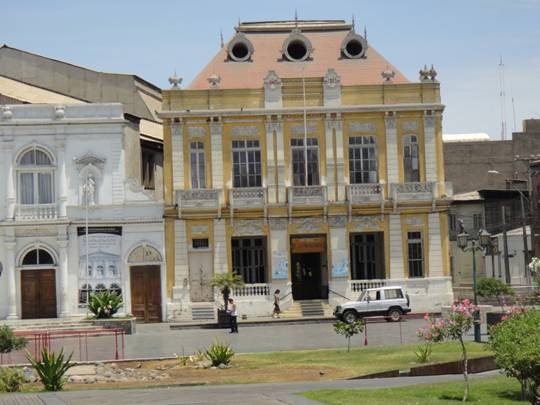
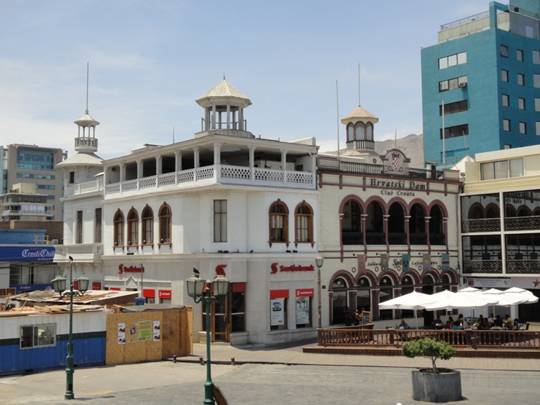
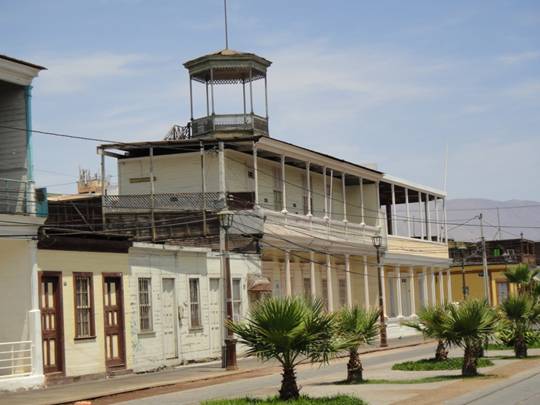
Iquique is a very attractive seaside resort city with a busy port and lovely beaches. The old part of town contains many beautiful old Victorian and Edwardian buildings dating from the heyday of the nitrate industry. The port still thrives due to a zona franca, where goods can be imported and exported duty free. We admire a full-size replica of the corvette, Esmeralda, a sailing warship with steam auxiliary power. We miss out on a chance to tour it, because their computer is broken and they can’t sell tickets. From 1879 to 1883, Chile, Bolivia and Peru fought the War of the Pacific over nitrate-rich territory and access to the sea. http://en.wikipedia.org/wiki/War_of_the_pacific The Esmeralda played a pivotal role in a sea battle which took place in the Bay of Iquique. Within sight of the city, she was rammed and sunk by a monitor-type vessel with armour plate, more powerful steam engines and much bigger cannons. The captain of the Esmeralda was injured and died shortly after his ship went to the bottom. Inexplicably, after this huge naval disaster, the captain became a national hero and the replica of the ship was created to perpetuate the memory of the battle. Chile did win the war, though and acquired strategically important territory from both Peru and Bolivia ... and every country needs a war hero!
|
|
|
|
Replica of warship Esmeralda |
Refurbished theatre in old part of city |
|
|
|
|
Clock tower in old part of city |
Beautiful old Edwardian building |
|
|
|
|
Classic buildings from the heyday of the nitrate industry |
|
We are very lucky in Iquique. A few weeks ago my brother came back from a visit with friends in Calgary, with the name and phone number of a lady who lives in Iquique. She is the sister of the wife of Alan’s friend and when she heard that we would be travelling in the area, insisted that we contact her. We ask for her help to find a hotel in the city, but she very generously invites us to stay at her house. Lynn has lived in Chile for seventeen years. She has a large house in a nice area and teaches English. It is a very nice break for us and we even get to do some laundry. We take Lynn out for dinner one evening and the next night she invites some Chileño friends for a barbecue. It is a great opportunity for us to meet some local people. J.C. works for the Canadian mining company, Teck Resources and Fernando is the Captain of the Port of Iquique. J.C. is a lifelong Socialist and was a fervent supporter of Salvador Allende in the 1970’s. Fernando is not a socialist and remembers the Allende era as a national tragedy when people didn't have enough to eat. Needless to say, the conversation is fascinating and we learn a great deal about life in Chile.
February 20
We want to travel by bus across the Andes to Salta, Argentina. Mike has heard
that it is a very appealing city and he wants check it out as a possible place
to spend a few months next year. Alas, the road through the mountains is
impassable due to the unusually heavy rains. We look for a flight, but it seems
that all air travel into Argentina has to enter through Buenos Aires. That
would mean flying to Santiago, then to Buenos Aires and then to Salta. We opt
instead to forego Salta on this trip and take a direct flight to La Paz, Bolivia.
Thirty minutes after leaving Arica at sea level, we step out onto the Bolivian altiplano at 13,500 feet. Our bodies do not care for this! We both develop headaches, slight nausea and I get a “fluttery” feeling in my chest. Needless to say, we don’t run to catch a cab and it is probably a good thing we don’t have to climb any stairs. Fortunately for us, the city of La Paz is considerably lower ... at only 8,500 feet!
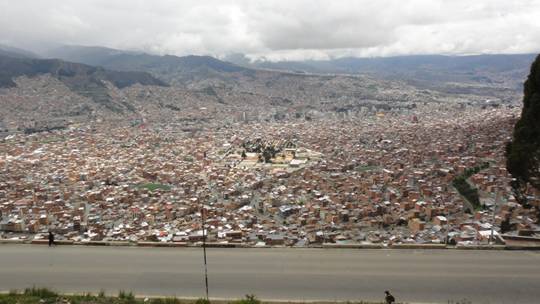
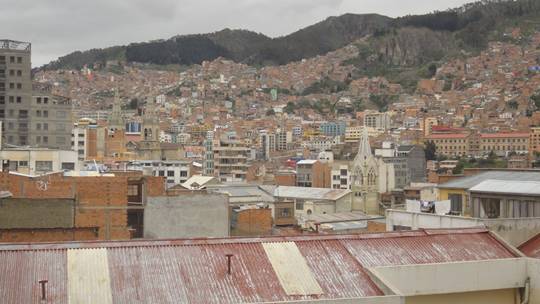
La Paz is located in a high alpine bowl and is a more appealing city than I expected. The buildings are all built of red brick and they climb right up the sides of the bowl. The streets up there must be unbelievably steep. I say that because the streets down here, more or less at the bottom of the bowl, are unbelievably steep! A climb from the central square, up several blocks of Calle Sagragado to our hotel, leaves us puffing and stopping to rest several times.
|
|
|
|
La Paz from a lookout on the way down from the airport |
View from our hotel room |
In most cities, the poor people live lower down and the rich build their
mansions up high, out of reach of the masses. Curiously, in these high altitude
cities, it is just the opposite. The rich people want to live as low as
possible, where there is more oxygen and the terrain is more level. As the
population of the city grows, the poor build their little houses higher and
higher up the sides of the bowl until you wonder how they manage to stay in
place. The poor people must all have one leg shorter than the other!
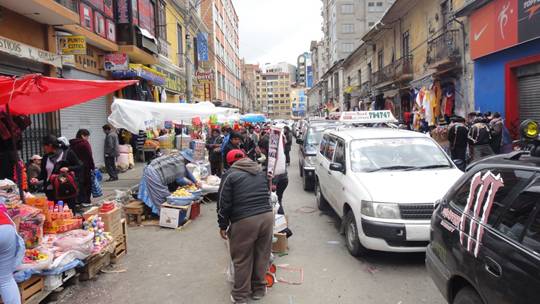
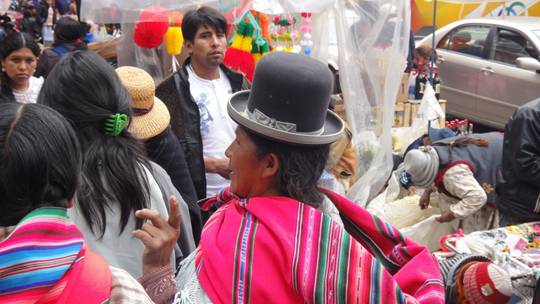
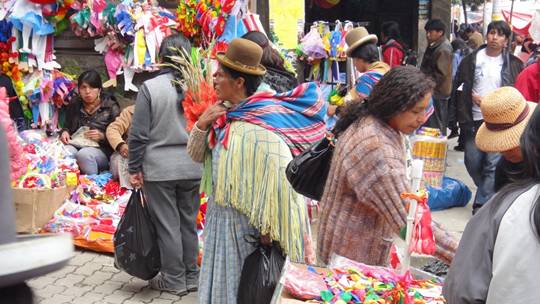
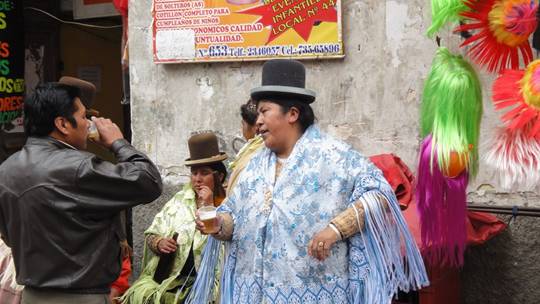
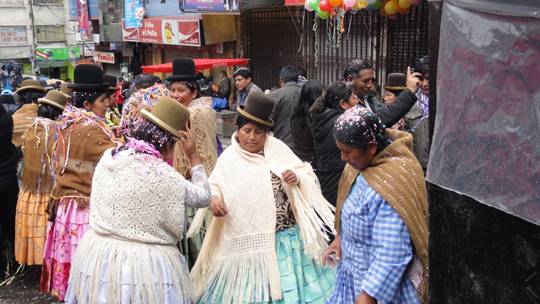
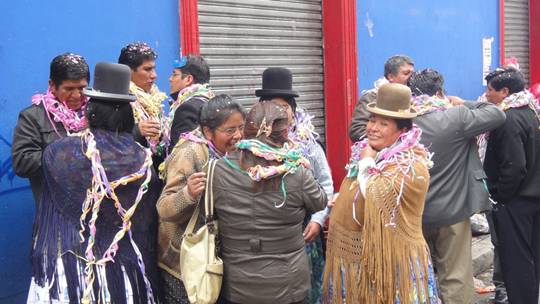
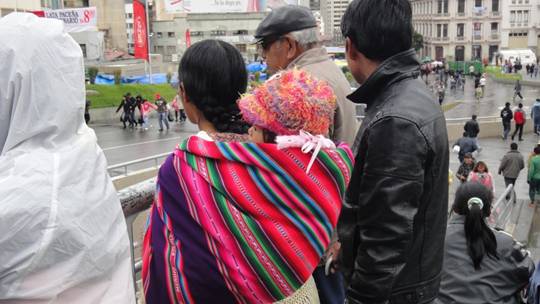
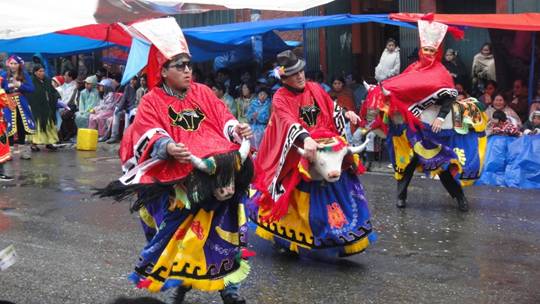
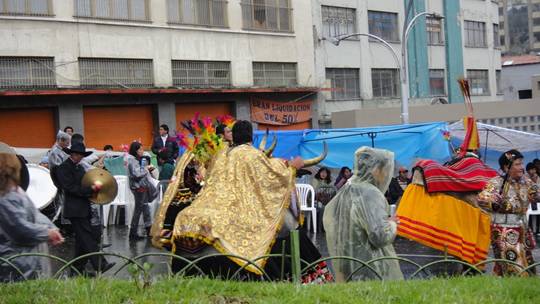
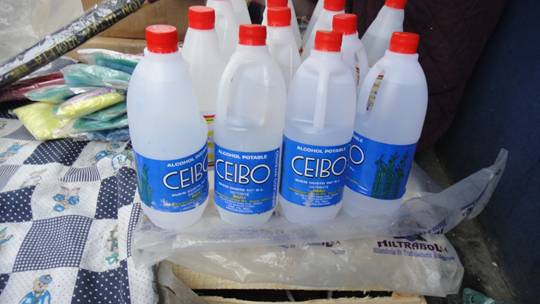
We arrive in La Paz on the afternoon before Fat Tuesday and Carneval is in full swing. Carneval isn’t quite so huge in La Paz as in some of the smaller country towns like Oruro, but everybody is certainly having a wonderful time. The streets are jam-packed with vendors and everywhere people are dancing and singing (and drinking beer). Street vendors also sell 96% potable alcohol in 500 ml and one litre plastic bottles. Here and there, bands are set up in the middle of the street, making music at full volume. Many people are wearing their traditional indigenous costumes; Bolivian ladies wear long, bright-coloured dresses and little bowler hats perched on the very top of their heads. The Aymara people are quite short and stocky to begin with and when the ladies put on all their shawls and many layers of crinolines under their long dresses, they look like basketballs with funny hats. Other people are wearing outlandish Carneval masks and brightly-coloured costumes. Almost everyone carries a spray bomb of some kind of foam, with which they spray unsuspecting targets. Kids also carry huge water blaster guns and it seems everyone is fair game on this day. Apparently, gringos have some kind of immunity for we remain relatively unsprayed, except for a couple of cross-fires that we didn’t see coming.
|
|
|
|
Street vendors are only allowed to set up during Carneval |
Aymara lady in traditional dress |
|
|
|
|
Traditional dress; different hat |
Carneval: a little music, a little dancing, a LOT of beer! |
|
|
|
|
During Carneval: girls just want to have fun! |
During Carneval: EVERYBODY wants to have fun! |
February 21 Fat Tuesday
We wander downtown and find that the
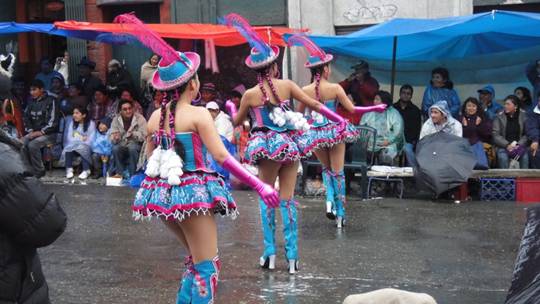
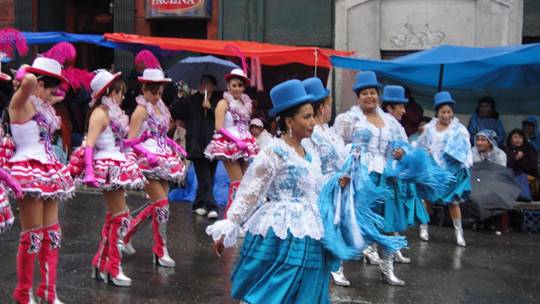
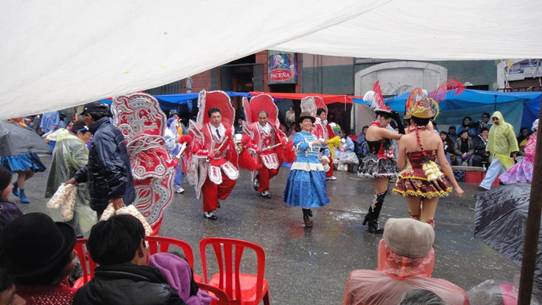
main street is blocked off for a huge parade. We watch it for hours, even though
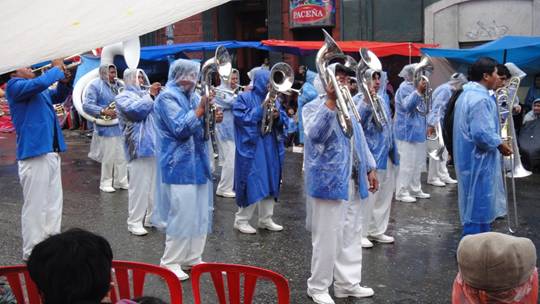
a fine Andean afternoon rain is falling. We buy plastic ponchos from a street
vendor like everybody else and stay more or less dry. The parade is
fascinating. Various clubs participate and they must spend most of the year
practicing and creating their costumes. Each group has a brass band that plays
raucous, somewhat repetitive tunes with an infectious beat that sets everyone to
dancing. Sometimes the group contains young girls in brightly-coloured but very
skimpy costumes, and there are also ladies in colourful traditional dress. Many
men wear bull costumes: a big bull head with huge horns in front and the rump
and tail out behind so it looks like the man is riding on the bull. Everybody
dances and prances joyously, the ladies swirl their long dresses up in the air
and the men swing their bull horns around, somehow managing not to gore anyone.
You would never think that people could dance with such abandon and never spill
the plastic cups of beer that they carry. Each club plays similar music and
wears similar costumes but they are all different in their own way and it is
great fun to watch.
|
|
|
|
|
Little one watching the parade in comfort; I could have used a woolly hat like that. |
Skimpy costumes – in the rain! |
|
|
|
|
|
|
Beautiful dancing ladies |
Outlandish costumes |
|
|
|
|
|
|
Amazing bull costumes |
||
|
|
|
|
|
A soggy band and the parade has just begun |
A little hi-test to warm you up: 96% alcohol |
|
February 22 Ash Wednesday
Today, the revellers are much subdued. There is still music here and there and
people enjoying the fiesta, but nothing like last night. We see one young man
at midday, sleeping quite peacefully in the doorway of a bank. Fortunately the
bank is closed for the holiday. We walk around the downtown, which looks totally
different this morning. Miraculously, the streets are all cleaned up, the
chairs and bleachers along the parade route have all been removed, but all is
not completely back to normal. We ask about a city bus tour and are told:
“Sorry, no tour today – the bus drivers are still drunk!”
|
|
|
|
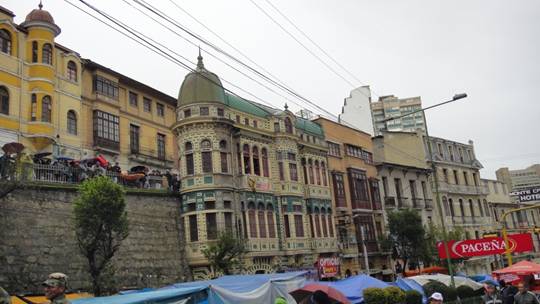
Beautiful old building, built into the side of the street ramp |
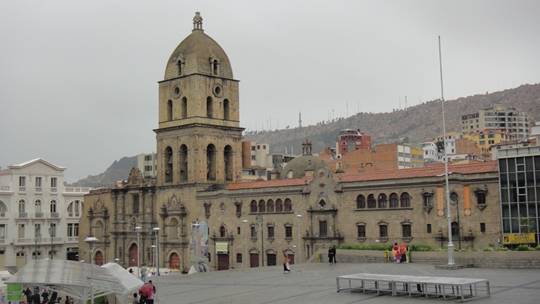
La Paz cathedral |
|
|
|
|
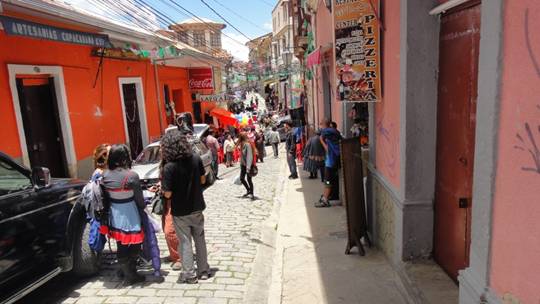
Mercado de las Brujas Witches market |
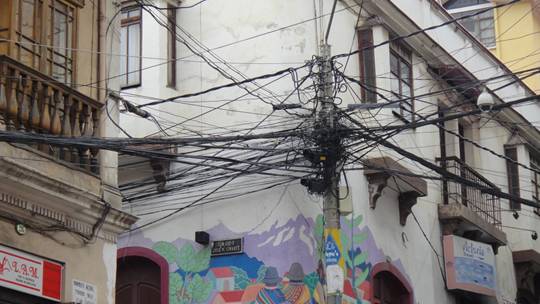
Third world infrastructure |
February 23
We book a bus to Copacabana, on Lake Titicaca. The bus picks us up at our
hotel, which sounds like pretty good service, but then it spends the next hour
and a half picking everyone else up at their hotels all over the congested
city. Well, at least we get our tour of the city. The bus powers up several
thousand feet out of La Paz and onto the altiplano. Suddenly, we are in a
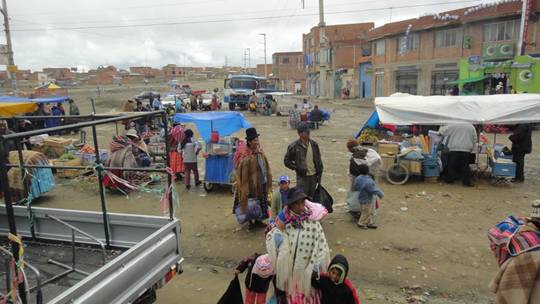
different world! The villages we pass through are bleak and cheerless and the
people look wretchedly poor. The excessive rainfall has turned all the dirt
streets into mud. Vendors hang blue plastic tarps over their little stalls to
protect their produce. The weather is typically cloudy, cool and rainy, with an
average daily temperature around 10°C – and this is summer! There is not any
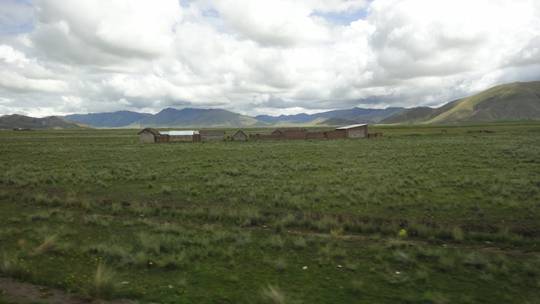
tree to be seen from one horizon to another. In the countryside, people live in
tiny adobe houses with straw-thatched roofs. There is no wood, so houses are
heated with dung fires. Most of the houses have no chimneys; severe respiratory
problems are common. The average life expectancy is around sixty-five years.
|
|
|
|
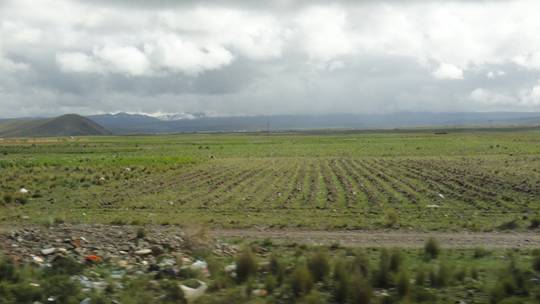
The altiplano |
Village market |
|
|
|
|
Adobe houses on the altiplano |
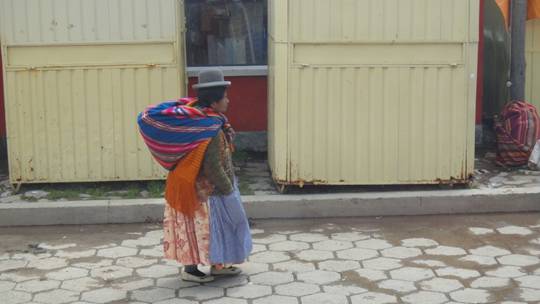
Aymara lady |
The scenery is spectacular – easy for someone to say that doesn’t have to live here! The altiplano is like a huge flat prairie, bounded by a mountain range on either side. It is very dry, but there is vegetation, not like the coastal desert. The people cultivate small patches of potatoes, the staple of their diet. The potato evolved in the Andes and there 3,000 varieties. The best and most nutritious varieties grow at high altitudes.
After some hours, we begin to climb higher into the mountains. Before long we are riding alongside a huge lake – Lake Titicaca. http://en.wikipedia.org/wiki/Lake_titicaca Once again, the scenery is spectacular; the road clings to mountainsides, high above the beautiful lake. Here, people are noticeably better off. We see many fish farms along the shore.
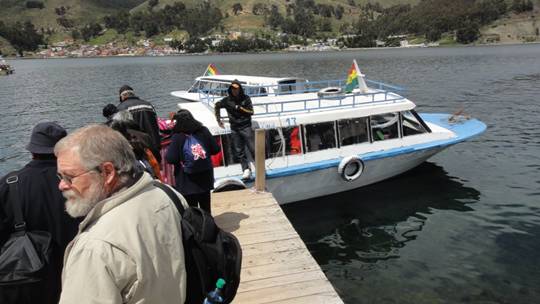
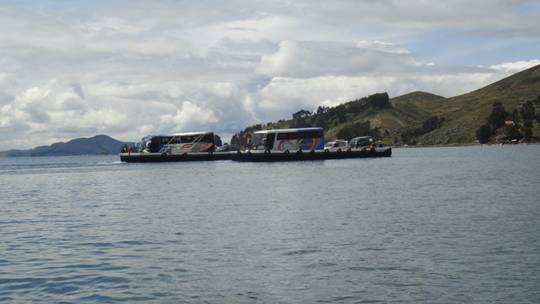
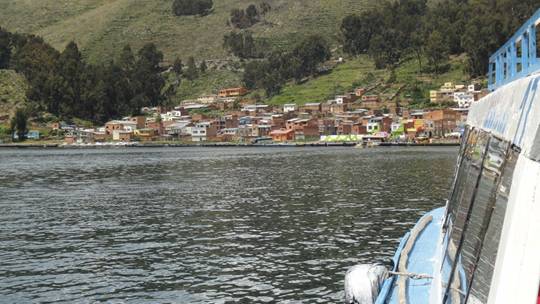
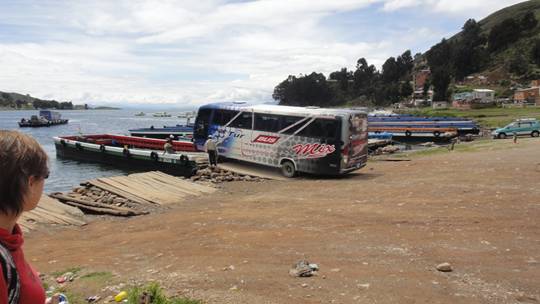
The road is interrupted at the Straits of Tiquina, a broad channel, connecting the two basins of the lake. We all troop off the bus and buy tickets for decrepit little wooden ferry boats that take us 800 meters to the other side. The empty bus is cautiously loaded onto a slightly larger, but equally decrepit, wooden ferry boat and makes its way to the other side. We climb back on board (after a welcome baño break) and continue our journey.
|
|
|
|
Ferry across the channel |
Buses travel on a different ferry |
|
|
|
|
Approaching the other side |
Unloading our bus |