
February 26
Both Mike and I solemnly promised our respective spouses that we would NOT visit
Machu Picchu without them, so we book a tour of the Valle Sagrado (Sacred
Valley) instead.
http://en.wikipedia.org/wiki/Sacred_Valley The Sacred Valley is considered
to encompass the heartland of the Incan Empire. Maria is our very professional
(and very attractive) Quechua guide for the day. The tour is ten hours
in duration and we cover a lot of ground.
|
|
|
|
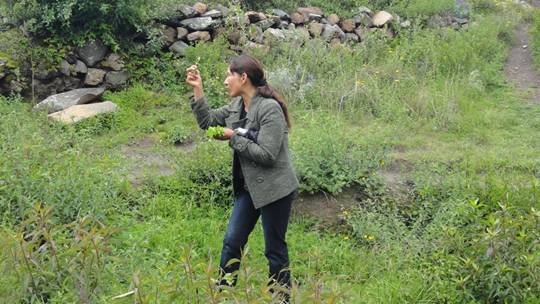
Our guide, Maria, showing us some medicinal plants |
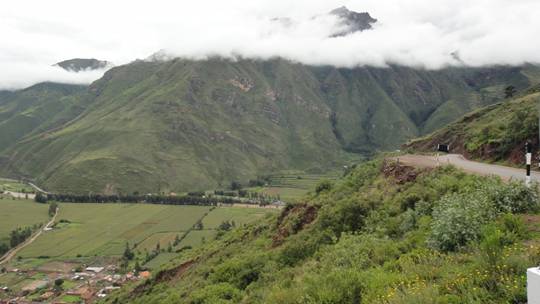
The beautiful Cusco Valley with the Urubamba River |
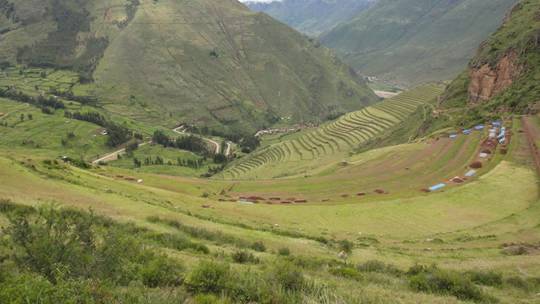
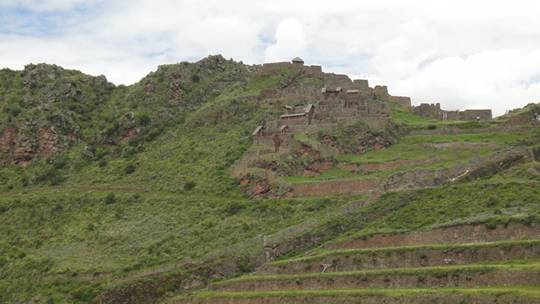
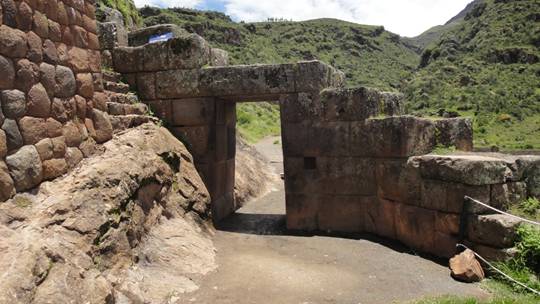
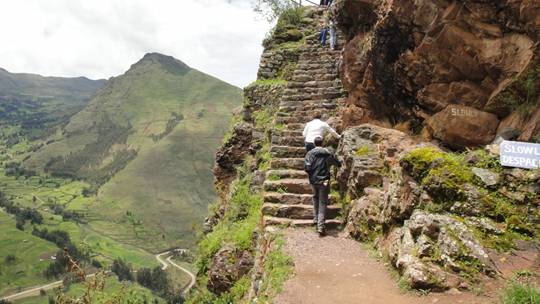
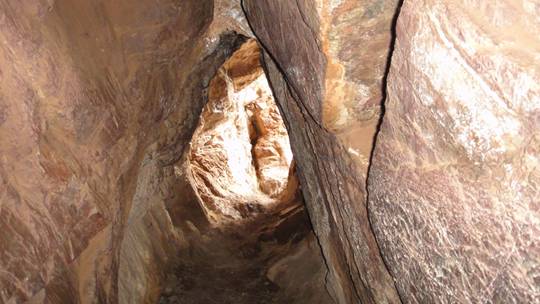
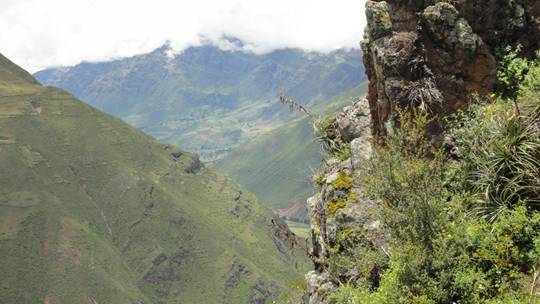
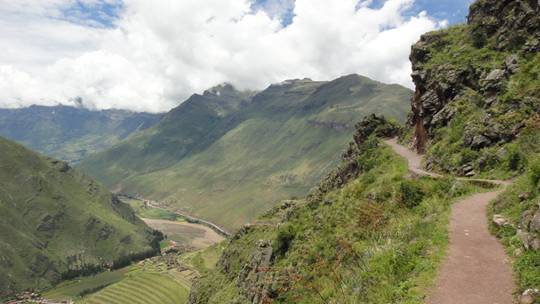
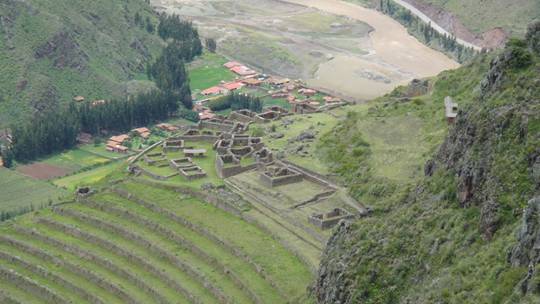
We first travel to Písaq, the site of a large Inca city, which controlled the southern entrance to the Sacred Valley. http://en.wikipedia.org/wiki/P%C3%ADsac The site is high on a ridge with breath-taking views of the valley and the Urubamba River. Mike elects to climb up to the Citadel, while I follow a narrow path, clinging to the cliff, to see the Inca Tunnel and the Watchtower. Guardrails and other safety features are unheard of in this part of the world. Our guide suggests if anyone has vertigo, they should stay close to the cliff-side of the path. The path is about four feet wide and drops sheer from the edge, hundreds of feet to the floor of the valley. The Spanish explorer, Francisco Pizarro and the conquistadores destroyed Inca Písaq in the early 1530s.
|
|
|
|
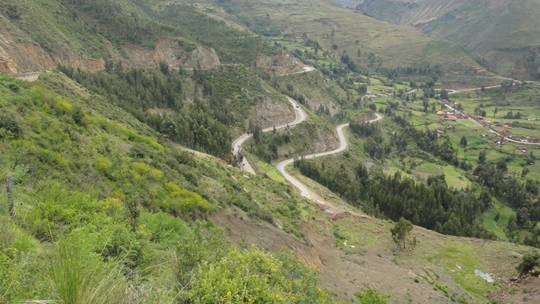
The road up to Inca Písaq |
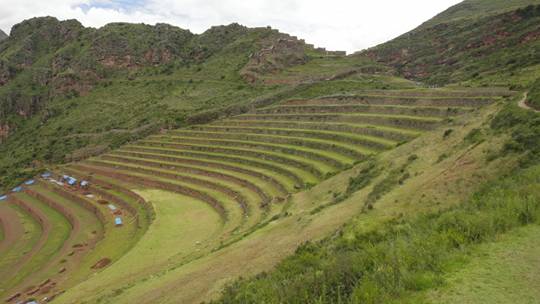
Inca terraces; citadel above |
|
|
|
|
Incan terraces; Urubamba River in the valley |
Citadel of Inca Písaq |
|
|
|
|
Gate with typical trapezoidal opening |
Not many guardrails in this country |
|
|
|
|
Tunnel |
Urubamba River far below |
|
|
|
|
Narrow path with sheer drops |
More Incan ruins |
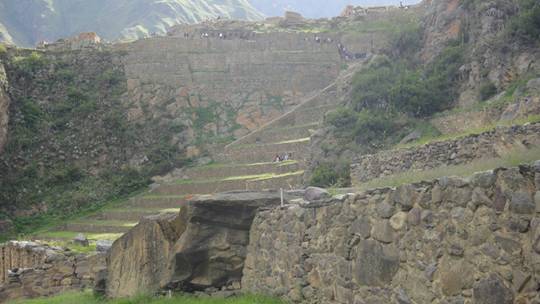
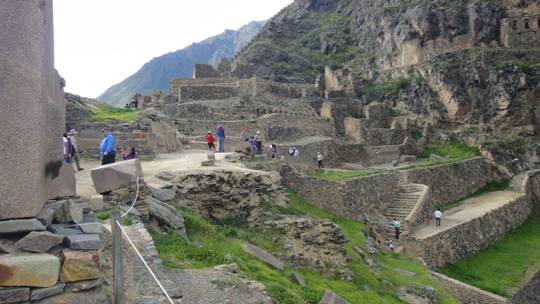
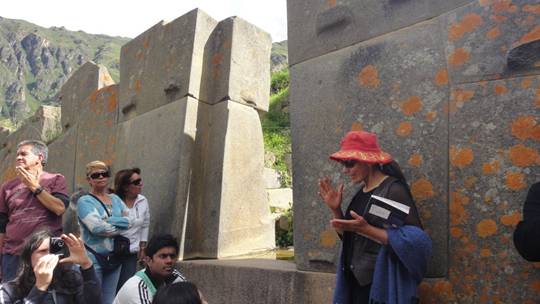
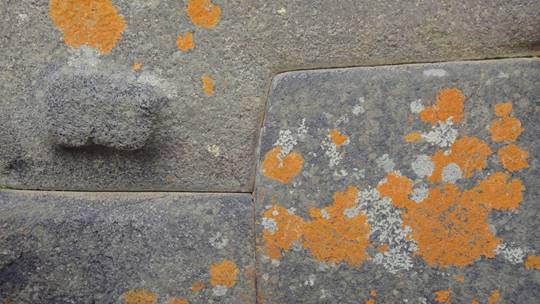
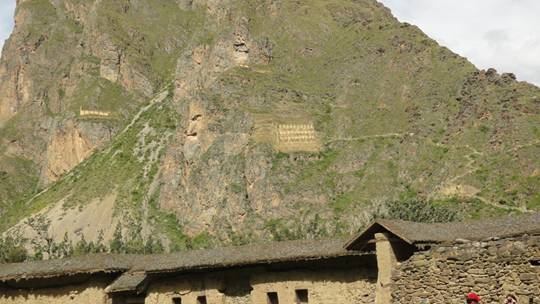
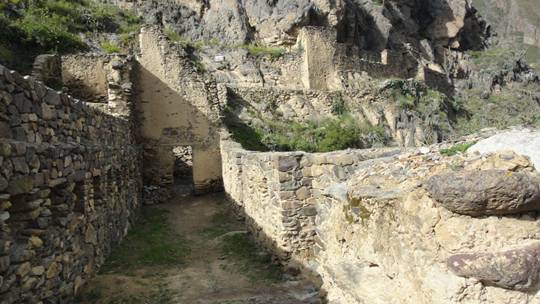
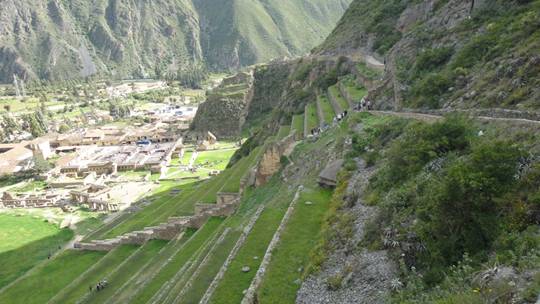
Next stop is the town of Ollantaytambo. http://en.wikipedia.org/wiki/Ollantaytambo It really isn’t possible to describe these sights in mere words! The main feature of this place is an elaborate temple, built high on a ridge to serve both religious and defensive purposes. The temple, itself, is built of immense cut stone blocks that weigh in excess of fifty tonnes. They are cut so precisely that a knife blade couldn’t be pushed into the joints. Even more amazing, is that these blocks were quarried from a mountainside, five kilometres away, on the other side of the Urubamba river. Using an elaborate system of wooden roads, ramps and skidways, the Inca people moved the huge blocks across the river, over the valley floor and up to the top of the ridge and then placed them precisely in position. Across another valley and high up on the side of a sheer cliff are stone granaries. It is believed that this location, combined with the cold mountain air and constant wind helped to dry and preserve the stored food.
|
|
|
|
Terraces at Ollantaytambo; they served both agricultural and defensive functions |
Temple high on the ridge |
|
|
|
|
Maria explains how the massive granite blocks were placed |
Amazing stone-cutting skills |
|
|
|
|
Granaries high on the cliff across from the temple |
Part of the temple complex |
|
|
|
|
These terraces are wider and higher, to serve as defences as well as for growing crops |
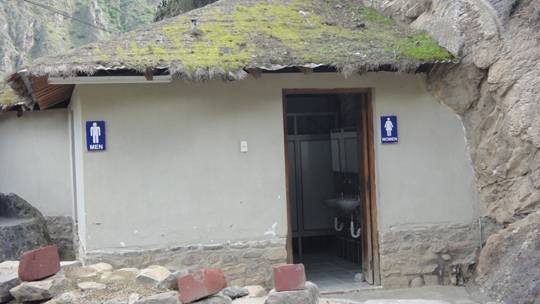
At our age, this can be a more attractive sight than any Incan ruin |
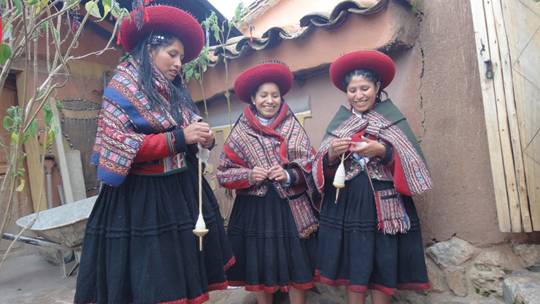
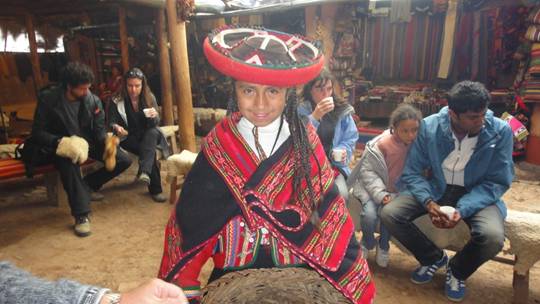
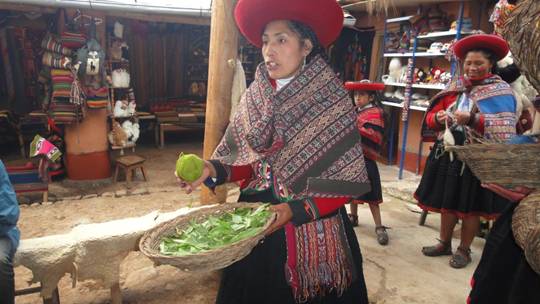
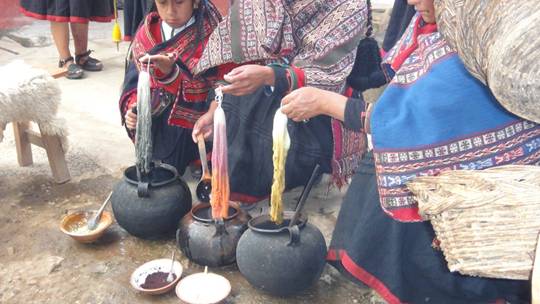
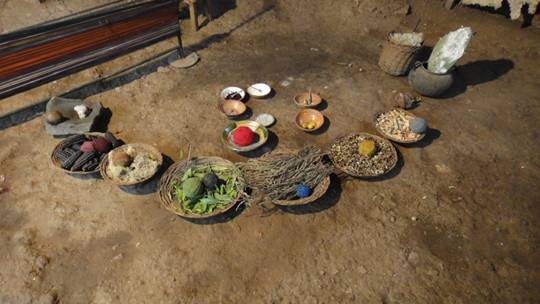
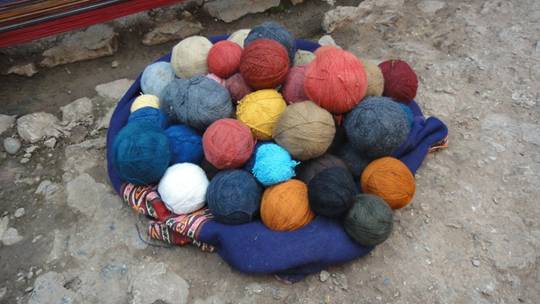
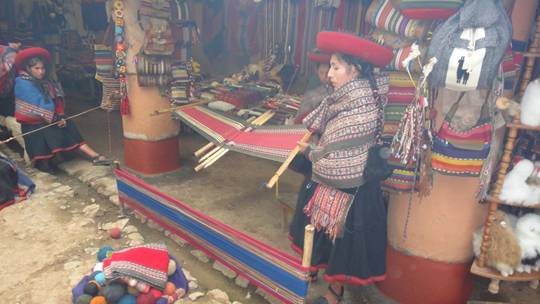
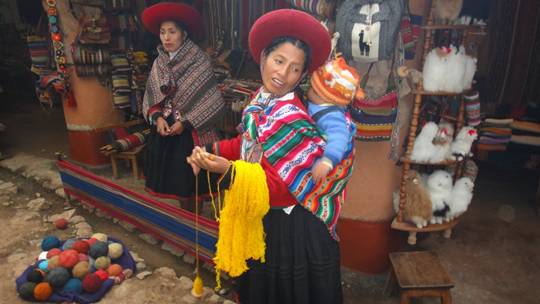
We proceed to the small village of Chinchero and at first we wonder why this is part of our tour. It has a pretty town square and a lovely old church and some Incan ruins, but after the astonishing sights we have seen so far, they seem unremarkable. But a rare treat is in store: a small textile workshop, where Quechua ladies in traditional dress, demonstrate all the steps in creating traditional fabrics. One of the ladies delivers a commentary in English and Spanish; it sounds memorized, as if she isn't really comfortable in either language. We sit on sheepskin-covered benches and sip cups of coca leaf tea. She first shows us how the raw wool is cleaned and washed. Then she demonstrates how different materials and techniques are used to dye the wool a rainbow of different colours. Meanwhile, the other ladies spin wool by hand, using drop-spindles. The commentator tells us that Quechua women spin all the time; while they are working, walking, cooking, caring for babies and “...even giving their husbands a kiss – no problem!” It is a fascinating demonstration and, in its own way, even more interesting than the archaeological sites.
|
|
|
|
Spinning yarn with simple drop-spindles |
Young girl serves us cups of coca leaf tea |
|
|
|
|
Explaining how various plants are used to dye the yarn |
Demonstrating techniques to produce different colours |
|
|
|
|
Many colours are created from natural plant and animal material; red, pink and orange come from the cochineal beetle |
|
|
|
|
|
Cloth is woven on simple hand looms like this one |
Baby rides comfortably in the shawl |
February 26
Our flight to Lima doesn’t leave until mid-day, so we have time to wander around
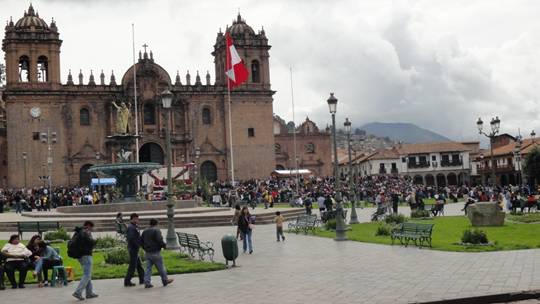
Cusco's central square and admire the several churches. Today is the last day
of Carneval and the city is packed with thousands of people, preparing for one
more party. We actually get a cab to the airport early because it looks like
the throngs of people might make it difficult to get out of the centre of town
later. Cusco is a beautiful city, although it is becoming a victim of its own
success. Because every tourist in Peru comes to Cusco, there are hundreds of
street vendors, which can be something of a nuisance. Each one either wants to
sell you their "original" art work for one Sol (about 40 cents), or give you a
one-hour massage. Every restaurant has waiters, trying to entice you inside and
if you stand still on the sidewalk for more than a moment, taxis cluster
around. Still, the Cusco Valley is a beautiful and fascinating place. We could
have easily spent a week, enjoying the city and visiting more of the surrounding
attractions.
|
|
|
|
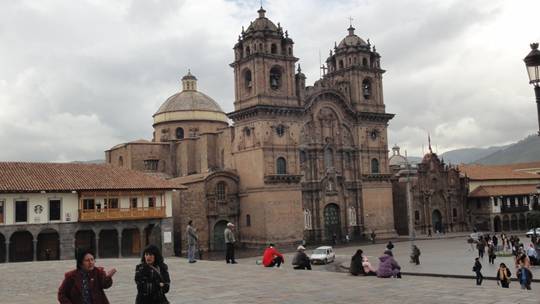
Cathedral in Cusco, on the Plaza de Armas |
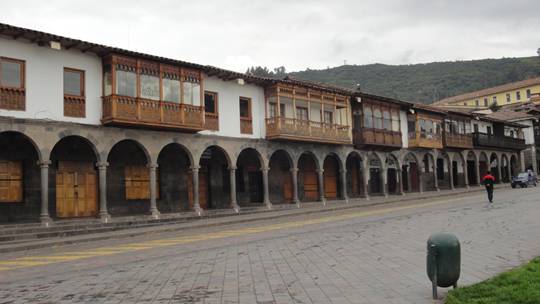
Arcades and wooden balconies are a signature of Cusco |
|
|
|
|
Another beautiful church on the square |
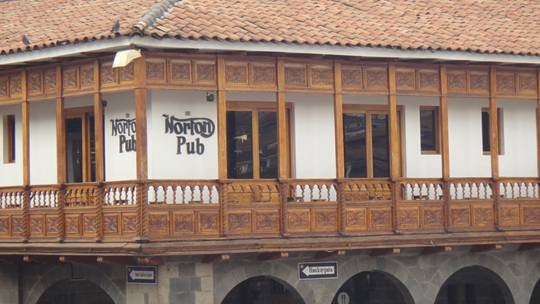
Pub obviously owned by a motorcycle aficionado |
|
|
|
|
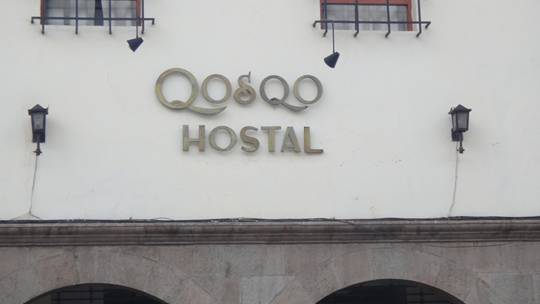
Quechua people pronounce and spell the city name "Qosqo" |
Crowds gather for the last Sunday of Carneval |
We arrive in Lima and check into Hostal Victor, where I am beginning to feel like a regular guest. It is still early in the afternoon, so we ask the hotel driver to take us to the coastal suburb of Miraflores. Lima is a big, busy city and pretty gritty, but Miraflores is more like a resort town, where tourists congregate and most ex-pats live. It has a beautiful big Plaza de Armas, which is packed with people on this warm summer Sunday evening. We find a pedestrian street with many restaurants, waiters standing at the entrances, vying to entice a couple of likely-looking gringo mochileros inside. We run the gauntlet, look at the menus and listen to the blandishments of the eager waiters. Eventually, we are seduced by a charming young Peruano whose family fled to the States during the civil war of the ‘80s. He speaks excellent colloquial English and also promises us free wine with our meal. We each order seafood ceviche and it is very good. The free wine arrives in tiny little glasses. Mike says to the waiter: “You are going to be pretty worn out by the end of our meal, if those are the biggest glasses you have!” Our hotel driver shows up exactly on schedule to take us back home.
February 27
Mike leaves in the morning to catch his flight to Guayaquil and then the shuttle
bus back to Cuenca. My Air Canada flight to Toronto isn't until 11:30 pm, so I
book another night in the hotel. For an extra thirty dollars, I can spend a
comfortable day, working on my stories, watching Spanish TV (better than CNN),
reading on my Kindle and having naps.
February 28
The 11:30 pm flight to Toronto doesn't leave until 1:45 am. Several babies
shriek continuously during the flight. Naturally, I miss my 10:00 am connection
to Winnipeg. The customer service representative cheerily tells me that she has
booked me on the next available flight: 10:50 pm – only 12 hours to wait! I am
put on the standby list for the 1:30 pm flight, along with ten other hopefuls,
but then they announce that the flight is already oversold; "…would anyone like
to give up their seat?" This does not improve my already cranky mood!
The 1:30 flight is all boarded, the gate attendant steps to the microphone and says: "Standby passenger Johnson?" I spring to full alert like a retriever searching for a duck! No sign of Johnson! The attendant says: "Standby passenger Skene?" His words are still echoing when I grab the boarding pass and race down the ramp to the plane. Life is good!
It was a wonderful trip. We saw a part of the world that, for some reason, is completely off the radar of most Canadians. Our nightly news contains little information about South American countries, unless there is a revolution or a natural disaster or someone has been kidnapped. Yet we marvelled at exotic and beautiful scenery and were astonished to learn about the scope and complexity of the fascinating Incan Empire. The local people that we met were friendly and welcoming. There is poverty that inevitably produces a certain amount of petty crime, so we took reasonable precautions, but we never felt as though we were unsafe or in any danger. Most of the people we rubbed shoulders with were South American tourists, travelling with their families during their summer vacation.
The civil wars and disruptions of the '80s and early '90s are long gone and each country is making huge efforts to re-establish their tourism industry. Infrastructure, hotels, restaurants, transportation systems and archaeological sites, is excellent and very professionally managed. Police and security guards in every city and town keep an eye on things and make sure tourists feel safe. They are unfailingly polite and helpful.
As Mike remarked more than once: "Things are different south of the Rio Grande". One does need a certain amount of patience occasionally, as Hispanic America moves at a different pace than we are accustomed to, but it just seems to add to the charm. If you would enjoy an exotic and fascinating vacation, you could do a lot worse than Peru's Cusco Valley.